
In biology, genetic variation often results in things that look more or less the same. Despite the panoply of genetic sequences in our cells, for example, we end up with a limited number of tissue types. This is known as canalization, the idea that, despite genetic variation, environmental forces, and randomness, lots of genotypes yield the same phenotype. This is why many different diseases cause similar symptoms. Or why body shapes are more limited than one might expect.
As a lapsed biologist, a favored pastime of mine is taking ideas from biology and applying them to other domains; parachuting into a field with a simple model shouldn’t just be the province of physicists! So I am tempted to ask where we find canalization in the world of metascience.
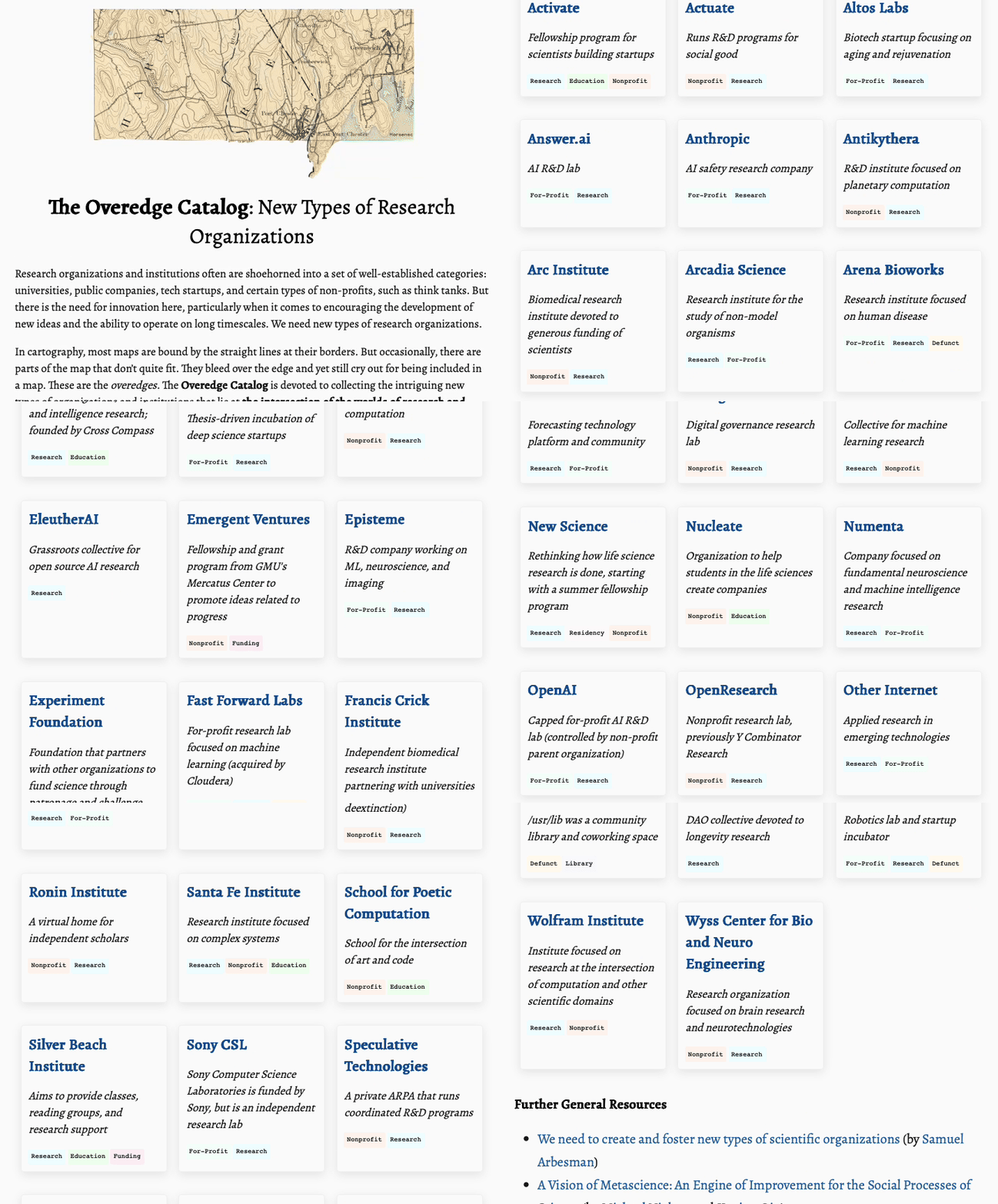
One obvious place to look is institutional forms, or “phenotypes” if you will. While there’s a high-dimensional space of possible institutional forms, we have traditionally only explored a small subset of it: universities, corporate research labs, startups, and a handful of others. Gratifyingly, over the past few years, there has been an explosion of new research organizations; researchers are trying new things and traversing this space, and I’ve been collecting them in my Overedge Catalog.
Yet, it seems that the new research organizations that have cropped up are not all that different from previous iterations. Many are cool and interesting, and I’m thrilled they exist, but, whether in the Overedge Catalog or not, many appear almost interchangeable in their structure. There has been a canalization of organizational forms.
If you go the route of a for-profit research lab, for example, your institution might end up looking like a startup. Or you might try to construct a strange research institution but end up with something that looks like an independent version of a university department, with colleagues that look like faculty and perform faculty-like tasks. While canalization is potentially valuable in biology in that it provides a kind of developmental robustness, it is probably not ideal for institutional innovation, as it constrains the form, and thus the function, of these organizations.
But why does this canalization occur in science?
Well, with organizations that end up looking university-like, it comes down to risk, or more precisely, risk aversion. Imagine you build a weird institution devoted to some odd interdisciplinary topic. Then, you hire people to work in it. These are often academic researchers with varying levels of exposure to academia’s incentives and requirements. Each hire then begins to think the following: “What if this organization crashes and burns? Or what if I’m simply not a good fit for it? I need to make sure I can get another job afterward.” And for the most part, “job afterward” means another academic job.
Thus, due to what metascience commentators Michael Nielsen and Kanjun Qiu term the “shadow of the future,” there is a certain amount of risk aversion: these employees still want to publish in traditional journals or do things that seem reasonable upon their return to the academic community. As Nielsen and Qiu note:
Scientists considering working for Jazzy Not-for-Profit (or for-Profit) Startup Institute must ponder: do they really want to give up publication in high impact journals? Or to work on risky projects that may not pan out? Or to do anything else which violates the norms of their scientific community? If they ever decide to leave their Jazzy Startup Institute job, won’t they then have a tough time finding another good job? After all, other potential employers haven’t changed their standards, just because Jazzy Startup Institute has. The shadow of the future looms strongly for such ventures, causing a kind of regression to the institutional mean … The perennial question within such organizations is: if I hew to local aspirations, will that damage my chances of getting a job anywhere else?
And thus, many of these organizations are funneled by their own staff, not necessarily even consciously, into similar kinds of forms. The people within the organization are driven to do academic-like activities, making the organization as a whole more academic. This “regression to the institutional mean” is a kind of canalization, yielding a smaller subset of forms than we might expect (or desire).
If, on the other hand, you go the route of trying to build a venture-backed R&D lab, you are faced with another canalizing force: investors and their money. While there are no doubt exceptions, such as investors with a great deal of patience and willingness for researchers to try lots of things, or companies like Genentech that made fundamental research breakthroughs, too often venture investment means a startup must do startup things. Ben Reinhardt, who runs Speculative Technologies (I’m an advisor), has written a wonderful little essay with the provocative title “When should an idea that smells like research be a startup?” Reinhardt writes:
A big reason that market uncertainty can kill researchy startups is less about investment and more about the fact that there is a tradeoff between an organizational culture that is good at addressing market uncertainty and one that is good at addressing technological uncertainty. At some point a researchy startup needs to do a dramatic gear shift into growth and product-market fit mode. This transition often either prematurely kills the research potential or the company dies because it’s being run by people with a research mindset.
To be clear, if venture investors push for this, that’s a reasonable and responsible part of their job (I work for a venture capital firm, for goodness sake!). A startup needs to scale to succeed within the venture capital model. Trying to bend this kind of structure and make it weird and capacious for research can yield valuable science, but it is unlikely to yield a fundamentally different and novel kind of institutional form.
Even when you have a single investor who seems mission-aligned, you can still end up with a reversion to the mean. Paul Allen, the cofounder of Microsoft, created Interval Research in the 1990s with lots of open-ended research, but within a few years, Allen asked for “less R and more D.” As one researcher there noted, “We’re moving from the ‘Let a thousand flowers bloom’ stage to being more tightly focused on commercializing our technology.” By 2000, Interval Research had shuttered. So it goes.
Yet another canalizing force is seen implicit in the first line of the excerpt from Nielsen and Qiu: the tax code. Due to my involvement in the space of non-traditional research organizations, I speak with many people who are thinking about building new institutions. A common question that I get asked is whether to go non-profit or for-profit. This decision will impact the kind of people or organizations they approach for fundraising, the regulations they will need to adhere to, and so forth, and these things should not be taken lightly. Yet, is it not odd that our tax codes have reduced the complexity in how researchers think about science? We imagine the vast and high-dimensional space of outlier research institutions, and then are forced to collapse it into these two categories because of tax implications.
Given these pressures, canalization might seem our destiny. However, I don’t think it is. There are clearly counterexamples to this narrative, where organizational structures exist that are indeed novel.
For example, focused research organizations seem qualitatively different and are something worth fostering: they blend aspects of startups and research organizations within a time-bound structure to construct something new. There was also a for-profit machine learning research lab called Fast Forward Labs that was entirely bootstrapped — taking no venture backing — that made money by producing quarterly reports about machine learning advances (it was eventually acquired by Cloudera). This was definitely different! And there’s Ink & Switch, which thinks about research work in terms of the Hollywood movie model, where teams assemble for specific projects, and then members might move on to something else.
But while it’s possible to push against canalization, it’s difficult. You have to try hard to avoid traditional incentive structures and do something far less pigeon-holeable. So what mechanisms might allow greater success?
One option may be to hire more weirdos or misfits (or whatever it makes sense to call those people less concerned with the shadow of the future). If these individuals aren’t thinking about returning to academic positions, this could allow an organization to avoid being channeled into academia-lite.
Or if everyone is obsessed with non-profits and for-profits, we may need to create new legal structures. There is the designation of the benefit corporation and even the B Corp certification, so perhaps, as a law professor friend of mine once suggested, we need an R corp? What would a Research Corporation look like, and what legal structure could allow different kinds of science to flourish within it? I don’t have the answer, but I think it’s worth exploring.
I think we might also just need more of these organizations, with funders willing to create the space and time for experiments to play out, rather than prematurely directing them into specific categories. This means that we need more rich people to do some really weird philanthropy, supporting crazy ideas in science and scientific organization. Hey, tech multimillionaires, be risky! Worry less about fitting the philanthropic mold and, instead, find people who want to make an institution that is truly different. The key for philanthropists aiming to start a successful research organization is simply to give money to interesting teams and then walk away. Minimize the oversight, lock the money up, and let smart people do their thing. Let the research take its time.
Or perhaps we need an institution that is really just a group of loosely affiliated independent researchers. That organization would have one person who fundraises for the researchers — The front man? The hype man? — and that’s it. Might this end up doing something truly different and weird? Let’s find out.
The National Science Foundation also recently announced its Tech Labs initiative to fund teams with large amounts of money for long stretches of time for research outside the traditional academic setting. This experiment is still in its early stages, but there are some exciting possibilities here.
Suppose, however, that your organization ends up succumbing to the forces of canalization. Even that’s not all bad. These are tried and true institutional forms, and they can still do great things. OpenAI, for example, has crept closer to the structure of a traditional tech startup over time, but it has certainly had an outsized impact on the world of AI. If, however, you want to explore the high-dimensional space of institutional structures, keep pushing for something new.
Samuel Arbesman is Scientist in Residence at Lux Capital and the author of The Magic of Code, Overcomplicated, and The Half-Life of Facts. In addition, he is an adjunct professor at Case Western Reserve University’s Weatherhead School of Management and a research fellow at the Long Now Foundation.
Cite: Arbesman, S. “Why Do Research Institutes Often Look the Same?” Asimov Press (2026). DOI: 10.62211/28jw-57eh
There's no darwinian / evolutionary process at play amongst scientific funding because we haven't nailed down a way to measure outputs we care about. Federal grants are collectively incentivized to avoid "risk" and private capital is incentivized to create near term (2-8yr) commercial value, prob why all bio investments ultimately become tx, diagnostics, or die
If we could measure outputs of scientific funding we care about (semantic diffusion throughout literature, commercial investment in identified IP, derivative job creation, data reusage, reproducibility, or sth) you could create darwinian competition _between funding models_ and figure out how we can produce more useful knowledge with the same public cash
The problem is that now, basically all federal funding perhaps with the exception of DARPA is deployed under the same incentive structure, so it's not at all surprising to me that they produce similar results.
Bottom line, we should measure scientific outputs we care about and then test many, many more funding models against each other instead of staying historically constrained / ossified. You probably wouldn't even have to increase science funding to do it, just carve out 20% of total funding for dramatic new models.
Great piece - the regression to the mean is real everywhere.