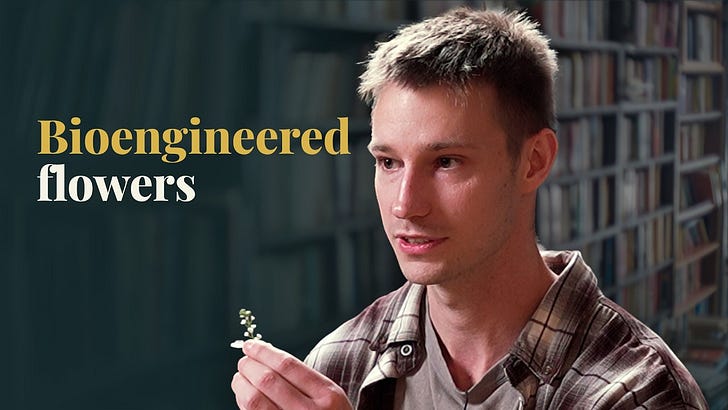
Nick Desnoyer, a plant biologist in Norwich, England, is designing and creating flowers that don’t exist anywhere in nature. In today’s episode, he reveals his next project: Paintunia, a petunia that acts as a living canvas.
Nick has engineered these petunias to include an inducible gene. When he lightly touches their buds with a clear molecule called dexamethasone, the molecules seep into cells, switch on the gene, and cause them to make a pigment. The result is a paintable flower, where molecules literally control which colors show up in particular places. Nick’s plan is ultimately to engineer these petunias to express three separate inducible genes, or biosynthetic pathways, for cyan, magenta, and yellow. For a prior project, Nick turned Arabidopsis, a small (and quite ugly) plant that researchers commonly use in research, into little pink “micro-roses.”
We filmed this episode surrounded by flowers. Nick patiently explained to me how each one gets its shape and pigmentation; how he combines breeding and genetic engineering to make new flowers; and how he searches scientific papers for mutations to figure out which plant crosses to make next. His ultimate dream is to build a botanical garden full of weird and wonderful flowers that exist nowhere else.
Watch on YouTube. Listen on Apple Podcasts or Spotify.
Sponsor: Plasmidsaurus offers whole-plasmid, amplicon, genome, and RNA sequencing. Place an order online, drop your sample in a drop box, and receive results with analysis the next morning. They handle the complete sequencing workflow so you can focus on the science. Sign up today at plasmidsaurus.com.
Timestamps
1:28 Paintunia
7:46 Tools for flower design
18:47 Petunia patterns
33:16 Engineering new traits
40:38 Turning Arabidopsis into pink micro-roses
54:26 Getting genes into plants
1:06:02 Mutant botanical gardens
1:14:24 Beauty is sufficient
1:20:30 Flower design studio
Transcript
Desnoyer: I would like to create a botanical garden that you walk into and you don’t just appreciate the flowers, but you actually understand them a bit deeper through a scientific lens. I want these flowers to only exist there. I want them to be weird and wonderful. When you walk through this garden, you get that feeling of magic in that when you walk through the garden, you’ll be forced to take a closer look at what’s going on. That once you leave this garden, you want to take a closer look at nature.
McCarty: I’m extremely excited for today’s interview, which is with Nick Desnoyer. He’s a plant biologist in the United Kingdom; a postdoctoral fellow at the Sainsbury Laboratory in Norwich, England, which is where we’re filming today. But more famously online, he’s known as a flower designer in that he designs and then creates his own types of flowers using breeding, mutations, and genetic engineering. If you can watch this interview on YouTube, that’s probably the best option because we have a lot of props. There’s a lot of flowers that we’re going to talk about. And let’s just get into it. Welcome, Nick.
Desnoyer: Thanks for having me. Very excited to be here.
McCarty: Let’s just start with the announcement. You’re working on a new project. You haven’t revealed it yet. Tell me about that.
Desnoyer: I haven’t actually talked about this project that I’ve been working on for a bit. It’s my next big project after the micro-rose. It’s called the Paintunia. The whole vision of the Paintunia is that it’s a living canvas. In contrast to a normal canvas that you would paint onto that’s made of dead plants, fiber and cotton, this is a living canvas that you actually direct it to paint itself. And I think there’s a lot of magic in that, which we can maybe get into.
McCarty: How does it actually work? It’s an engineered line of petunia, and tell me about it. We have it on camera.
Desnoyer: We have it here. This is the first version. There’s going to be many iterations. The final concept is that you would add three different inducer molecules. These are small molecules that you can treat to the floral bud at different stages and different concentrations. And based on those treatments, you direct transcription factors that lead to the expression of pigment biosynthesis genes that become turned on after about 16 hours. And so in a way, you’re orchestrating the gene expression of the flower and you get some feedback from the flower after you’ve treated it to see how the molecules diffuse through the flower. How is it responding to different pigments being produced in the same place? Things like that.
McCarty: This is one of the flowers here. And so this is not actually a flower that you made, right? It’s from a 20-year-old science paper, research paper.
Desnoyer: Yeah.
McCarty: But they basically made an engineered line of petunia that when you paint it with this small molecule called dexamethasone, it turns those regions pink as the flower opens. And so you get this. This flower has actually been painted.
Desnoyer: We have a few more of them as well. You can see that you can make different patterns based on how you treat it. And so I want this flower to really become a medium for art, where the flower really becomes the canvas. I’m calling it Paintunia because it’s based on Petunia hybrida, which is probably the second most studied flower in the world just after Arabidopsis. But there’s a lot more known about the colors in Petunia versus Arabidopsis. It’s the most studied in that realm. And what’s really nice about it is you see you have these five fused petals that are papery thin. They’re like three cell layers thick. And so it really seems like a perfect canvas.
McCarty: You want to take this line essentially that somebody had already developed and you want to add more colors so that there’s different small molecule inducers that would turn on a cyan, a yellow. How hard do you think that’s actually going to be?
Desnoyer: This might actually be the first time that you have a flower producing all of these different classes of pigments. For example, flowers that make betalains don’t typically make anthocyanins. And so we don’t necessarily know how those blends of colors are going to look.
McCarty: But what color is a betalain? What color is an anthocyanin?
Desnoyer: Right. Because this will be a living canvas for painting, it needs three major colors, cyan, magenta, and yellow. And with this, you can make blends to reach the entire color spectrum. Right now I have magenta, which is anthocyanins, but I’m going to eventually make this to be the cyan, or at least try and get close to cyan. For cyan, I’m going to now cross this to ornamental varieties that are a bit more blue. A mauve. Actually, I think we have one here. Yeah. In this background, this is also anthocyanins, but it’s a bit more blue. Ideally, it would be a perfect cyan. I’m going to try and introgress some of the anthocyanin biosynthesis genes in this background into that flower. When you add the dexamethasone, it turns a bit more blue. And then for the magenta, I’m looking for betacyanins, which are betalains.
And then for the yellow, I’m going for either betaxanthines or carotenoids.
McCarty: Do we have a yellow one?
Desnoyer: Oh yeah, down here. This is a more newer line. I think this one popped up about five years ago. And this one was exciting because they didn’t have a true yellow petunia before this. This one’s called Bees Knees and it’s a completely different class of pigments. It’s called carotenoids. This is probably accumulation of beta carotene within the chromoplasts. But what’s cool is that once you now have this true yellow, you can cross this to all the anthocyanin lines and then see how does this pigment blend with the others.
McCarty: Is that what you’re doing? To get your second color for the pentunia?
Desnoyer: Totally. For example, if you were to cross this yellow with this dark purple line, you get a flower called Black Mamba. And this is... I wouldn’t say true black. It’s almost a philosophical question about what true black is. But because you have all these anthocyanins that are absorbing a certain spectrum of light and the yellow doesn’t overlap with that spectrum, it’s just absorbing a lot of the light. And so you get kind of a black flower. The reason I’m going for CMYK and not RGB is these are two classes of colors. What RGB is, is additive. So it’s like a screen. A screen starts as black and then you add red color or you add blue color and you see how those blend. Whereas in real life when you’re not illuminating something, but it’s rather the absorption of the light, it’s subtractive. And so that’s why printing in physical paper is CMYK.
McCarty: When you actually think about designing a flower, what are the dimensions that you can control? What are the sorts of parameters that you think about? And how much can you actually deviate from natural designs?
Desnoyer: I break it down into two major principles of flower design that helps me organize all the thoughts. And this is a simplification. It’s just based on the visual of the flower. There’s other dimensions like smell and taste, maybe even hearing that we can get into. But this is just based on the visual. I think of sculpting the flower and painting the flower.
In terms of sculpting, you can think about rearranging the architecture of the flower. That’s where and what organs are placed and how many. And then once those organs are placed, how are they shaped? Their size and shape, that’s more organogenesis. And then on the painting side, I think of changing its color or pigmentation and then where those pigments are placed. The patterning with those four major principles, you can think about designing any flower you’d want.
McCarty: For example, this flower here, this is just a wild type flower, right? This is a plant that people bred probably to look like this. People have basically been creating flowers that have certain forms for thousands of years, right?
Desnoyer: Yeah.
McCarty: In terms of construction or the first part of this, the sculpting: is there really any additional benefit you get from genetic engineering? Or is it basically all breeding?
Desnoyer: Right. Just for some context, there’s about 300,000 flowering plant species. And then when you think about all the varieties that we’ve made, it’s tens of millions, even the varieties of the wild type and the ones that we’ve bred. What’s really beautiful about breeding is anyone can do it. It’s extremely accessible. All you need to do is just cross two flowers, collect the seeds and then start selecting the traits that you like. This goes back like 10,000 years. For example, modern corn comes from tiosinte, also a flower. And this has actually been fundamental to the success of humanity. It’s probably the biggest driver of human success is flower breeding. And so there’s breeding for purely aesthetic purposes, but also obviously breeding for food. It’s very powerful. Almost every flower you find in the grocery store has been bred, and you can make so many different forms and funky colors, everything under the sun.
Bioengineering, in contrast, it’s a bit more modern and new, and you have, I would say, less control. I would compare it to kind of like levers that you have that you can introduce to create new traits. And what I’m really interested in is creating traits that you wouldn’t be able to make with breeding. And so with breeding, you’re stuck within the plant family that you’re able to cross these flowers with. And so if you try and cross this rose with another species of rose, maybe they’re incompatible. All you have is the natural genetic variation, which still there’s a lot. Every single one of these petunias comes from an original cross of Petunia axilaris from like 200 years ago. But what really makes me excited is with bioengineering, you break out of that natural variation and that plant species and you can access the entire tree of life.
And so then you can think of all the molecular inventions that evolution has created. And so some of these flowers are taking molecular inventions or genes from bacteria, fungi, humans, you name it.
McCarty: The thing I’ve been most impressed by, hanging out with you the last two weeks, is that you have this somewhat encyclopedic knowledge of papers and mutations and phenotypes. You can recall things such as, “Oh, in 2002, this lab made this cross. They found this mutant and the flower had these traits.”
Desnoyer: Yeah.
McCarty: So basically, a big part of your design process is just knowing which mutations people have already found and what that led to in the flower. And then crossing those in interesting ways. There’s actually not a lot of genetic engineering involved, right? There is in the designs and we’ll talk about other projects later where you’re adding pigments and these things. But the sculpting process seems to be finding the right mutants and then breeding them.
Desnoyer: Right, exactly. It’s not like a typical design process where you would start with a customer and think about what’s the ideal product for them and then go back and this year limited to the code. It’s like, what can the code make? And do we know the code that makes that? And so for example, in Arabidopsis, it’s the most studied flower in the world. It’s got 34,000 genes and we know the function of most of the important ones. And so that is like a whole sandbox for genetic engineering and all the tools that are made for Arabidopsis. That’s probably the most powerful medium for genetically engineering a flower in terms of sculpting.
McCarty: There is a database of Arabidopsis mutations. Basically, there’s so many people who study that. But you started working in Petunia and there are much fewer known mutants, right? Why do you not spend the first part of your project just making mutants? How difficult would it be to just make a ton of Petunia mutants and discover your own phenotypes?
Desnoyer: Well, I would love to do that. But at the moment, it’s just me and a colleague, Juan Pablo. And I still have a postdoc project, actually, that consumes most of my time. But the ideal scenario would be that I have a garden, I have every possible mutant, I can do mutagenesis and pick up ones that aren’t even found yet. And so most of the diversity that I’m actually working with, they’re commercial cultivars or they’re from the Amsterdam Petunia germplasm collection, which is maintained by Francesca Quattrocchio and Ronald Koes, who have totally helped me get into this.
McCarty: If you wanted to make a huge library of mutants, how would you actually do that? How do people mutagenize flowers and then screen for phenotypes? I would imagine it’s just a lot of waiting. Are they using chemicals? Are they using x-rays? Does it matter what you use?
Desnoyer: There’s a lot of ways you can mutate plants. A famous one, especially in Arabidopsis, is called EMS, which is a chemical that induces—causes the polymerase to make more mistakes and you get all of these mutations. You soak the seeds in this chemical mutagen. Another way is fast neutrons. I don’t know too much about this, but I guess you blast it with neutrons. And this is—breaks the DNA and then repairs, possibly. Another way is actually just putting them in full sun. UV radiation induces more mutations. Well, that all falls under breeding. One of the coolest ones is transposon-mediated mutagenesis, and this is a really cool flower here. This is actually why petunia was a major model organism for so long, is because they found this mutant. This flower, it’s now called W138. It originates from a commercial line called Roter Vogel, which means red bird in German.
And some scientists brought this into the lab and they made it inbred or they tried to homozygose it so that all the progeny are more or less the same and you can have reproducible results. But something cool popped up, which is that this transposon had jumped into one of those transcription factors that regulates anthocyanins, AN1. And it popped in just at the border of an intron in this gene. And so the transposon, it’s about 230 base pairs and it’s extremely unstable. But essentially the scientists saw this. They saw all these streaking patterns. They could tell that a transposon is moving. And then they just propagate this plant knowing that this transposon is going to excise and jump into other places of the genome. And so most of the mutants that we have for Petunia derive from this line and you can figure out what the causal mutation is quickly because they know the sequence of the transposon, so you do flanking PCR.
And they maintain all of those mutants actually in Lyon, in France. I’ve heard that they lost actually all of them due to a flood, which is really sad. And so when I was at the Petunia Community Conference, they were talking about how do we reestablish all of these mutations? What I think would be a really beautiful project actually is because these are wild type, but they don’t have any transgene, these you can grow in your garden. And so I would love to have a community breeding project where you give this out to like 10,000 gardeners. They can cross it to their own petunias or just have these grow and document these transposition events and the weird things that pop out. And this could come along with a guidebook of all the mutants that we know in petunia. They could figure out what the causal mutation is.
McCarty: And so these patterns of red, right? These are basically cells where the flower is naturally white. The flower is naturally white, but when you see the red, that means that the transposon has jumped.
Desnoyer: Right. This is in an AN1 mutant background. And so the flower is typically white because it has no anthocyanins. And the mutation is this DTPH1 transposon that sits within the gene. And so it can’t be fully translated because it has an early stop codon, but when it jumps out early during the petal primordium development, then it restores its function and all the function of all its daughter cells. And so you get these sectors where you can essentially trace the lineage of that cell. And depending on when that transposon jumps, you’ll have a different size of the sector. These really large sectors that happened really early. Whereas if it jumped really late in development, you can have it even in a single cell.
McCarty: There’s other petunias here too, right? Let’s talk about more petunias.
Desnoyer: Sure.
McCarty: That’s the transposon petunia. What are these ones?
Desnoyer: Let’s see.
McCarty: This is called Night Sky, right?
Desnoyer: Yeah.
McCarty: What’s going on with Night Sky?
Desnoyer: You can tell this one’s Night Sky because it has all of these white spots, but the spots can actually be much different than this. This is an example of post-transcriptional gene silencing. I think this one’s even cooler. It’s like an inversion.
You almost have this Rorschach looking pattern and you can see it’s quite diffuse. If you see this diffuse white and not a dark purple background and you especially see this gradient of color going white to red, you can be almost certain that that’s post-transcriptional gene silencing. Because these are actually—the silencing is mediated by small RNAs and these diffuse through the plasmodesmata. And so you get these gradients along the border. Whereas the transposon that I showed before, this is a genetic event. And so there’s none of that diffusion. This is actually where post-transcriptional gene silencing was discovered.
McCarty: Tell me that story.
Desnoyer: This comes from another petunia background called V26. It’s a really purple line. It’s this one right here. And I think it was back in the 70s, maybe 80s, some scientists wanted to make this flower even darker purple. And so they overexpressed one of the early genes in anthocyanin biosynthesis called chalconsynthase. And when they transformed this plant and overexpressed it, it actually didn’t get darker purple, but it reverted back to white in many cases. And so I think like 40% of the transformants, it went back to white or had these weird blotchy patterns or circles or even star patterns along the Corolla fusion sites. And there was a WTF moment when that happened. Apparently the first author of this paper was bringing it around showing people, coming up with crazy explanations about how this could be because back then they didn’t know about gene silencing.
McCarty: And there’s some other petunias here too, right? This is the original transposon line?
Desnoyer: Roter Vogel, I believe. This is a nice coral red. This is just another flavor of anthocyanins called peligronin.
McCarty: Why do some anthocyanins look red and some look purple?
Desnoyer: It’s just they have different enzymes that shift the pathway. Anthocyanins are a pretty complicated biosynthesis pathway where the compound is being hydroxylated or glycosylated. And so depending on the presence or absence or expression levels with these different enzymes, you shift it towards different colors. There’s actually an even another layer of the coloration, which has to do with the acidity of the vacuole. These anthocyanins, they move into the vacuole, which is quite acidic environment. And then depending on the pH of that, they can change from blue to pink. Like hydrangeas that you may have in your garden if the soil is really acidic, it’s more blue. If it’s more basic, it’s more pink.
McCarty: And what else? Let’s see. You brought a lot of petunias, right? What’s going on with this petunia?
Desnoyer: This one. You have Queen of Hearts, King of Hearts. This one, we didn’t know actually what it’s called. My colleague called it Silent Prince. As you can imagine, this is also post-transcriptional gene silencing.
McCarty: This looks much more controlled.
Desnoyer: It looks much more controlled, but the breeders still don’t even know why. It’s in this star pattern. And so with gene silencing in petunia, it’s the reason for almost all the patterns. But they don’t know why it arises in certain places. They’re learning more and more about that though.
McCarty: Just to be clear, this flower would normally be purple. It’s just the gene encoding the purple gets silenced at a certain point in development. And so that the cells that become these white part of the petals look white. And you were telling me too, while I’ve been here, that most flowers are just naturally white, right? White is the default state of flowers.
Desnoyer: I would say white is, you could say, the default state of all the organs and that you just have pigments that are expressed over it. And so sometimes you get an effect called virus-induced gene silencing in leaves. And scientists often target the gene called PDS to know if the virus-induced gene silencing is working. And in that case, you get all these white sectors in the leaf and that’s because the chloroplasts are being degraded where the chlorophyll isn’t accumulating and so it goes back to white. You can get a fully white leaf.
McCarty: And so last petunia here.
Desnoyer: Oh yeah.
McCarty: I’m interested in this one because it has this really beautiful—the color flows through the veins. It looks like veins. What’s going on here?
Desnoyer: This one, I don’t actually know. But I would assume that you have more anthocyanins accumulating in the vasculature. Probably the phloem companion cells. There is a promoter called SUC2 that’s a really famous promoter for phloem companion cells that you can drive the expression of different genes. And so perhaps it’s more stressed within the vasculature and so you have more anthocyanins. There’s actually a gene expressed there. But it’s an interesting exercise to think, if I want to now bioengineer this flower, how do I access the different domains of the petal? How can I just get it along the margins? How can I get it just within the veins or the center or these spots?
McCarty: It’s basically when you think about your design, you’re looking to nature. You see things that pop up naturally. And then in your head, you’re like, “Oh, I bet I could figure out a way to use that!” Like getting color in the vasculature or adding new layers of petals like this, right? Double stacking petals.
Desnoyer: Right.
McCarty: Or using gene silencing to get these really beautiful patterns, which is just amazing, right? It’s like you look to nature, you see the natural variation. Then you’re like, “Oh, I can cross these things to get the features I want.”
Desnoyer: Or you think, how does the plant make this? How can I reverse engineer that with bioengineering?
McCarty: Which also makes you look more closely, probably.
Desnoyer: Totally. It completely actually changes how you view nature. And I think that’s the most beautiful part of the project. It’s like how your job influences your perspective on life. If you’re a carpenter, maybe you’re just always looking around at the wood and taking a closer look at that. I probably didn’t even think about what type of wood this table is made of. But it influences how you see the world. And so as a flower designer, you really start to look at all plants as amazing inventions of evolution. And it really sparks your imagination as to how they make these things.
McCarty: This is technically a petunia, even though it doesn’t look like it, where the leaves are forming...
Desnoyer: There’s basically no petals.
McCarty: So it’s leaves. One thing I’ve noticed is why don’t we see flowers that have green? Surely there are green pigments or there’s ways to put chlorophyll back into the petals. Why do we not see green flowers?
Desnoyer: If you don’t find something in nature that means either it hasn’t evolved because it’s not fit or because it’s something really difficult to evolve. This is the case of the former. It’s just not very fit. As I mentioned before, petals have the sole purpose of attracting insects and having them pollinate them. And so a green petal may not stand out to a pollinator. In fact, it may attract more herbivores that want to eat that petal. Obviously there’s many ways you can make a green petal. All you need to do is have it revert back to sepal identity or not lose its chloroplast. There’s tons of mutations that you can do to make that. But that doesn’t typically evolve.
McCarty: But if you wanted to, could you breed this in the lab to enlarge these so that it looks like a flower that is green?
Desnoyer: Yeah. There’s a flower that we don’t have here, but it’s called the Picasso petunia. It’s actually my favorite and it’s like a lime green, with pink pigmentation in the center. It’s less dramatic than this, but I would imagine that those petals have a bit more leaf identity. There’s also quite a few pathogens that actually infect plants in order to revert the flower back to a vegetative state. And these bacteria are usually transmitted by insects. And so it’s kind of co-evolution of the flower, the insect and the bacteria where the bacteria is trying to revert the flower back into food so that it recruits the insect. And then when the insect eats the flower, it obtains the bacteria and then moves to another flower. There’s also some ecology in flower design.
McCarty: The other color that I basically never see is true blues. There’s a lot of purples. We see blues in animals, right? There’s blue lobsters. Why do we not see blue flowers?
Desnoyer: I was looking for the most blue one we have here, but it’s a bit more mauve. And actually when you call something blue, you have to be very careful because it can be a bit scandalous. There was the first blue rose that came out. It’s called Applause. It came from a company, Floragine. It took 10 years to make. And when they produced it, they said, this is the first blue rose. But anyone with eyes can see it’s purple. And so the blue, it’s like, as you said, it’s really rare to have true blue pigmentation. You’ll find a lot of blue in nature, but a lot of it is structural color. It’s some kind of co-evolution between underlying pigment and then bending that light using structural variation on the cuticle or the waxy surface of the petal. And so that tells you something: that tells you that blue actually is fit, right, because it evolves.
And so it’s really that second category of it’s just difficult to evolve. And that’s probably because there’s something about blue compounds that are hard to biosynthesize or we don’t have the code for or the chemical is unstable. The most classic true blue in flowers is a flower called, I think it’s butterfly pea. It’s known as Clitoria, so you can imagine what it actually looks like. And there’s a guy here at the John Innes Center that actually did his whole PhD on Clitoria and defining what are the anthocyanins that lead to blue in this flower. And so he actually shared his PhD with me. And it’s amazing because he has the whole lore of blue pigments in his introduction. It’s also a beautiful thing that you can do storytelling about all the different colors. We could sit here for the next two hours and talk about every single color and all the organisms that have evolved different ways of making those colors and where they’re from.
And blue is an interesting one.
McCarty: And there’s also this flower that you were telling me about that turns translucent when it rains and it’s native to Japan. What happens with that flower? Why does it turn transparent?
Desnoyer: Yeah. That flower, it’s called the skeleton flower. And actually most petals, if you soak them in water or infiltrate them so that they become completely full of water, they will become transparent. If I take a white petunia and inject in water into the air spaces or the mesophyll of the petal, you’ll be able to see through it. That’s because it’s not an actual white pigment that the flower has. It’s more that it’s just diffuse light. And so that’s caused by the difference in the refractive index of the cell wall of the cell in that air space. And so the air’s refractive index is somewhere around one, and the plant cell wall is like 1.5. And so when it goes through the plant cell wall, it bends the light and then this hits another plant cell wall, bends. And so you get light scattering everywhere.
Of course, this looks white. But when you fill it with water, the refractive index of water is one. It’s very close to air. And so it just goes right through and is transparent. And so I imagine with the skeleton flower, it has large stomata or has some way of becoming soaked really easily.
McCarty: Have you thought about designing flowers that turn transparent?
Desnoyer: I haven’t actually, but that would be a cool one. You would need to probably get rid of the waxy cuticle on top of the flower because flowers don’t want to become soaked. When you get soaked, it’s really easy to get a pathogen infection because it’s full of bacteria. Most plant surfaces have a waxy coating to prevent that.
McCarty: Do you feel like we’ve mapped all the levers? So you also have this thing with smell, right? You have an ongoing project. But smell—are there, beyond smell, are there other levers as well? How big can we really go with flower design?
Desnoyer: I think you’re kind of limited in what code we have and what code has been discovered. And with bioengineering, I see it as complementary to breeding; you can create traits that you wouldn’t normally get within that plant family. And then once you create that, you can start to introgress it into different lines with breeding. Flower design encompasses both breeding and bioengineering. The exciting part of bioengineering is you can create traits that would have never evolved within that plant family. For example, recently people made a glow-in-the-dark petunia; the firefly petunia from Light Bio that’s being sold in the US. It’s a bit dim, but still it glows in the dark and it’s literally emitting photons and recycling the substrate for the luciferase, which is quite incredible. And so things like that get me really excited about new to nature traits and also this adventure aspect of biology in which you look out over the entire tree of life, at what are all the molecular inventions we have, and then thinking creatively about how can we implement those to create new patterns, new colors, and new structures.
McCarty: And what is the smell project that you’re doing?
Desnoyer: The smell project, we first wanted to go for something that we are very sensitive to, which is the smell of rotting flesh. And so there’s a few carnivorous plants. They’re called malodorous plants because actually they want to attract insects and want to mimic rotting flesh. Like Rafflesia, which is the biggest flower in the world. It’s in Malaysia, this really large red flower. But it produces a chemical, DMDS, through a two-step pathway that was recently discovered. And so actually it was my professor now, Sophien [Kamoun], who knew the person that discovered these enzymes and was like, “You should make smelly petunia.” But this is also potentially cool because maybe you could attract new types of pollinators like flies. So we synthesize the genes and we always test them first in bacteria. We always use microbiology to do quick tests, and so we boosted the expression of these two genes in bacteria and the first thing I did was make a liter of this bacteria and I let it grow overnight.
It’s a bit of a funny story because the next day I came in so excited to see if it really smells horrible and I was actually a bit worried because when I walked into the building, the whole building smelled like sewage and people were even talking me about how they couldn’t work there. And I immediately went white in the face. I was like, oh no, this is all because of me. But there was also a part of me that was like, by God, we’ve done it. And I’m thinking that this is going to be the most legendary story of the Sainsbury lab. And so I get closer, I’m telling people, I’m like, I think it’s me. And I get closer to the shaker where we’re growing the bacteria and I open it up and it smells just like E. coli.
And so it just so happened that the same day that I grew this massive flask culture of this corpse flower gene bacteria one of the sewage pipes had broken. With that said, when I smelled the bacteria it still smelled a bit like sewage, and we did a blind smell test throughout [The Sainsbury Laboratory] where I brought people controls that don’t have the gene. And they did double blind smell tests, and seven out of seven people could distinguish them. Now we’re going to see if putting these genes in petunia, if it triggers that smell. You’ll need the precursor of the metabolite and the gene product will have to be in the right place of the cell. Those are always the two considerations. And if those work, then we hope to actually test it with different pollinators, seeing if we can do pollinator switch.
I would love to have petunia, which is normally pollinated by hawk moths, hummingbirds and bees to now be pollinated by flies.
McCarty: Why did you choose a bad smell instead of a good smell?
Desnoyer: It’s just the first thing actually that came up. Sophien just happened to know a person that was working on it. But later, after telling this story, I realized it’s actually probably the best thing to go for first because it elicits a really strong reaction. And some people really don’t like it and some people love it. And probably the best art is art that divides the audience or produces a really strong emotional response. And what produces a more emotional response than the smell of rotting flesh in a flower? But it’s also a beautiful art project because it questions what is beauty. To us, we’re like, oh, this is a disgusting flower and maybe also to the hummingbird. But now that it’s attractive to the fly—well, beauty is subjective. The fly may find that flower more beautiful. And so it brings up this interesting question.
McCarty: And also, of course, flowers did not evolve for our aesthetic sense. They evolved to look the way they look to attract pollinators, right? That’s the whole function of the flower.
Desnoyer: Almost every flower that you can find in nature which is insect pollinated is a physical manifestation of what that insect finds beautiful. And so over generations and generations, they keep selecting what they find the most beautiful. And it’s a physical manifestation of that insect’s aesthetic sense.
McCarty: Let’s talk about Arabidopsis. Your first flower design project was micro-roses, which were basically Arabidopsis that you bred and then you added a transgene to get color. And so let’s just start with the wild type. This is normal Arabidopsis, right? It looks so unremarkable. And that’s because you were saying plant breeders have just inbred it for generations. Why were they inbreeding it in the first place?
Desnoyer: Scientists continued to self it so that it became an almost completely homozygous line. That means all the seeds from that plant will have more or less the same traits and that makes experiments more reproducible.
McCarty: I see.
Desnoyer: Oftentimes if a scientist wants to adopt a new model organism for plants, the first step is to make it either double haploid where it’s completely homozygous or you just keep selfing it for like 10 generations.
McCarty: Basically they just breed it with itself until all the progeny are the same.
Desnoyer: Right. But still they are slightly different. If you were to find wild type in different labs around the world and sequence them, I’m sure that they would each be slightly different. And this actually may lead to some discrepancies in results. There’s also different wild type backgrounds. There’s Landsberg, there’s Columbia, there’s Erecta, and then there’s tons of other ones. But the most common one which you see here is Columbia, like Columbia, Missouri.
McCarty: If you were to walk around outside though, you would see Arabidopsis all over the place. But it wouldn’t really look like this, right?
Desnoyer: No, it would look very, very similar. I believe even in the wild, Arabidopsis thaliana is still mostly selfing. Which is a sad story because once a plant evolves a selfing strategy, it’s very efficient at the beginning because you can produce a lot of seeds. But it’s more or less an evolutionary dead end because you can’t create any new variation.
McCarty: And so when you started to think about designing Arabidopsis, what was the first thing that you did?
Desnoyer: Actually the first time I designed Arabidopsis was with fluorescent proteins. My PhD was all on plant reproduction and I was doing live imaging of double fertilization within the flower. But through this, I developed all these different fluorescent lines of the flower. And so I started to cross all of these and actually think of it as genetic painting with fluorescent proteins, trying to highlight different parts of the plant. And then a new tool came online that actually a postdoc brought into the lab. I still remember his journal club on this paper. And he brought in a tool called RUBY And RUBY is three genes from beetroot—CYP76AD1, DODA, and a glucosyltransferase gene—separated by P2A linkers that are self-cleavable so that you get one mRNA that can produce three proteins. It’s elegant. And they use this as a selectable marker or reporter for gene expression.
And so this postdoc, he wanted to put it under a pollen promoter because we all studied the pollen. He wanted to use it as a marker for tracking the pollen tube growth. But he noticed on the single cell level, the pollen tubes are still translucent, so it didn’t really work. But there’s a lot of serendipity that occurs when you transform a plant with a construct like RUBY. It can have multiple copies or it can go into different parts of the genome. And so he picked up all these transforming lines that had pink pigmentation in the full flower or just the petals or just the pollen. But for his experiment, it didn’t work.
McCarty: Right.
Desnoyer: He was ready to throw them away. But me, having played with genetic painting of fluorescent proteins for so long, I was like, wow, this is actually visible. At the same time, right next to these flowers, I had these agamous mutants. And in short, instead of producing petals, sepals, stamens and carpels, they produce sepals, petals, petals, sepals repeating. It becomes an indeterminate flower. And I was teaching a course. That’s why I was growing these flowers, and the students always love this one the most because it’s actually the genetic underpinning of a lot of commercial flowers that you see in the grocery store that have this double flower phenotype. They’re like little roses. I crossed a carrier of agamous—these don’t produce any reproductive organs—with this RUBY line. This is actually a funny story because it was a carrier for agamous, but this is a really old EMS allele.
And in fact, we have no selectable marker for this mutation.
McCarty: What does that mean, EMS?
Desnoyer: This is a chemical mutagen that can induce mutations. Back in the early days, people were mutating Arabidopsis to do forward genetic screens, where they would treat them with EMS. They put the seeds in the chemical and then look for interesting mutants that pop up. And you know if your EMS worked, if some of the leaves have white sectors, but also about one in 10,000 plants will yield an agamous mutant. They use this as a proxy to see if the mutagenesis worked. But to propagate these is quite hard because these ones don’t make seed. The only way to propagate these would be to vegetatively cut them, which you can’t do with Arabidopsis, or propagate them through carriers of the mutation. So you find wild type looking plants that would be heterozygous for the agamous allele. But because this is an EMS allele and we didn’t have any selectable marker for it and we couldn’t even genotype it, I do it through classical genetics where I plate all the seeds of a wild type looking plant and see: does the mutation pop up in the next generation?
And so all I did was cross a plant which I thought was a carrier for agamous. I had only two thirds chance that this was a carrier and crossed these two plants. And so in an alternate universe, that plant was the one third that was wild type and didn’t get anything. And I would have just trashed them. That’s what I mean by there’s a bit of serendipity in it. And so I crossed these two flowers. I grow the first generation, which is called the F1, filial one. And again, I’m not genotyping them. Also I don’t know if the progeny carry the mutation and they’re just a little less pink than this because now they’re heterozygous for that. I selfed that plant and then in the F2 hoped to find some pink little micro-roses popping up. In the F2 population, then deriving from this cross, I found a few plants that were homozygous for agamous, as in they had this double flower phenotype, and homozygous for the RUBY, which looked a bit like this.
I thought this could get a lot more interest within the course and that this actually might be a better way to reach the public than genetic painting with fluorescent proteins. And so I brought this through the entire institute showing everyone I could find and was met with mixed reactions. So the younger students, like the undergrads and the masters, they were like, “Whoa, that’s so cool. You transform this into this and now it’s big and pink.” But when I brought it to the postdocs and the professors, they were like, “Yeah, you made a cross. Now get back to work. What are you doing?” But I was quite convinced that people will find this cool especially when you compare the wild type and the new version to show people what you can do with biotech.
I had already been making scientific art that I put online for about four years up until that point. And I posted this post and it was the first time that people actually reached out to me offering money. And I had always hoped that this would happen one day. And so I was really excited after I made this micro-rose, I showed it to my professor and he was like, oh, you could introduce this mutation and this mutation to make it larger or to have more petals. And so I took that as inspiration to upgrade these roses over the next year. And so rather than looking at it as a potential startup, I was exploring it more from an artistic perspective of: is flower design a real thing that we can do? Or is it just a simple cross like the postdocs were saying? And this was one of the most exciting times in science because it really for me, because it started to change how I saw the science.
I was writing my PhD, but also exploring all of the literature of Arabidopsis research, which has over 10,000 papers on it. But now I was starting to see the utility of this research actually. When you try and make something out of a flower, you start to see what are the actual impactful papers that we can start to create stuff with. I started skimming these papers and looking at them more as catalogs of mutations: what could make these flowers a little more aesthetic? And there’s very few genes that actually make the flower a little more aesthetic. I went for about five and I just ordered some primers for CRISPR and started to transform these pink roses with the CRISPR. And I also went for a few low hanging fruits of what I thought could be achieved with bioengineering, but not breeding, which is making the flowers interactive; such as using inducible gene cassettes that you can add a small molecule and you can direct the production of pigmentation.
Over the course of the year, I explored many different combinations of mutations and many different transgenes to control the color. And all the while I had this vision in my head of a flower that’s—instead of being sepals, petals, petals, sepals, which makes it a little bit mangly—it’s much larger. It has sepals and just petals, petals, petals all the way down, is a bit more symmetrical and large, and has a bleeding red center, which I thought I could achieve with the inducible system. And so I remember clearly going to bed and having this burning vision of: I want to create this. And over the course of the year I explored a lot of funky things, realized what works, what doesn’t. And around December 2024, one line popped up that was homozygous for erecta, agamous, and superman and heterozygous for clavata3.
And it had the RUBY transgene as well in the background. It had about five different edits you could say. And this—I was extremely excited because it was much more beautiful than, in my eyes, than the original. And this time—and when I brought it through the Institute, I was met with much different reactions. In fact, I brought it to some professors that had worked on Arabidopsis their entire career. Like 40 years. And they were asking me what species it was. And so I took that as affirmation that I’m onto something.
McCarty: What were some of the interesting micro-roses that you got? And if you were still working on that, are there other colors or what else were you thinking in terms of expanding that?
Desnoyer: Right. Some of the other genes that I explored were more to do with organogenesis. There are two genes, DA1 and EOD1, that regulate the size of the petal. As I mentioned before, petals are dispensable and their shape and size don’t really affect their physiological function. And so you can introduce mutations like frl1 that make frilled edges or da1 and eod1 that make them larger. You can introduce mutations like clavata3 that actually affect the floral meristem size and balance. That’s where you also get some kind of freaky things that look like fasciated flowers or even tumors.
McCarty: We have a fasciated flower, right?
Desnoyer: We do, yeah.
McCarty: Show that.
Desnoyer: This is almost certainly a fasciated stem. And so the vegetative meristem likely became too large at some point in this mutant background and all the stems started to fuse together.
McCarty: But yeah, it’s like two stems. It’s like a very thick, flat stem. I’ve never seen a plant like this.
Desnoyer: But now that you’ve seen this, you’re going to start finding it in nature, especially if you look at dandelion. Dandelion clonally reproduce and so they don’t have much genetic variation. And so they’re very prone to making mutations. And sometimes they get mutants in clavata3 and start to fasciate like that.
McCarty: And that also happens in the meristem, right? Instead of one center, it has a split center.
Desnoyer: That’s right.
McCarty: Basically to sculpt the flower initially, you were doing crosses with mutants and your professor suggested some other things you could cross in. But then you started to do CRISPR. And I’m curious about that because before I came here to visit you, I had no understanding of the plant world. It was almost like a mystical thing when people would talk about tissue culture or whatever, or agrobacterium. And so maybe you could walk me through that. When you—we have some plates here, and could you explain what some of these are and how you actually get genes into the Arabidopsis?
Desnoyer: There are many ways you can get a gene into a plant. It depends on which species you’re working with. Arabidopsis is such a famous model because you can really easily transform it. And so you put your genes into a bacterium called Agrobacterium that occurs in the wild. This naturally infects plants and produces what’s called crown gall disease. Chemical signals from the wounded plant, such as acetosyringone, activate the Agrobacterium. The bacteria produce this secretion system, which is like little needles that poke into the plant cell, and they’re able to insert what’s called T-DNA. In the wild, this T-DNA carries tumor-inducing genes. And so the plant essentially becomes a home for the bacteria and starts to feed them metabolites. Some really clever scientists thought, “Oh, we should just take away those tumor-inducing genes and use this beautiful invention for inserting genes into plants.”
And then there was a guy who took that Agrobacterium and just dipped the flowers of Arabidopsis in the bacterial solution, collected the seeds, and found that, wow, this is enough to get that gene into the egg cell of the flower. The next generation then carries the stably integrated gene.
McCarty: You can just dip them into bacteria?
Desnoyer: Exactly. And that only works so well in Arabidopsis because of the development of the flower. There’s a stage very early on when the carpels, which eventually bear the seeds, are fusing and make a furrow. During that stage, the Agrobacterium can get in, and later the carpels enclose it. And that’s what infects the cells that become the egg cell. So it’s really based on the anatomy of Arabidopsis. If you dipped this petunia in Agrobacterium, it wouldn’t work.
McCarty: And so, speaking of petunia—to transform petunia, which I know we’re jumping back, you have to use tissue culture, right? How does that work?
Desnoyer: Essentially, for petunia, you take a cutting of one of its leaves and put it onto a medium with different concentrations of phytohormones, namely auxin and cytokinin. With the right balance of these phytohormones, the cells go from a differentiated state back to a dedifferentiated state, like stem cells. And they start to produce what’s called callus. Callus is totipotent. It’s undifferentiated cells that can produce an entirely new plant.
So what you do is, early on, when you cut the leaves, you co-culture them with the Agrobacterium. The Agrobacteriumstabs into the leaf cells and inserts its T-DNA. Along with that T-DNA, you add a selectable marker. This could be something like the RUBY transgene that colors it or an antibiotic-resistance gene. After the co-cultivation, you kill all the Agrobacterium with antibiotics and put the leaf tissue on a selection medium that again induces the callus. This time, only the callus that carries the transgene is going to survive and produce a whole new plant.
And so then shoots start to grow from this leaf and produce the next plant. Eventually, you move it from a shooting medium into a rooting medium, which has little to none of the phytohormones, so that the shoot can start to produce roots. The auxin and cytokinins actually have different modes of regulating genes in the shoot and the root.
McCarty: And so the process—if you have to do tissue culture, like for petunia—takes much longer, right?
Desnoyer: This one might even have a date on it. Actually, this is when we transferred it. But I can tell you this one is probably two to three months after cutting the plants. It’s quite remarkable. This whole plant came from a single cell from a leaf.
McCarty: There’s a physical limitation in how long it takes for a plant to grow. But when you dip Arabidopsis, you can immediately take it and regrow a plant, right? How much faster is it to transform and grow the next generation of Arabidopsis versus petunia?
Desnoyer: Right. Arabidopsis takes about a month and a half to grow. You can get flowers within four weeks. You dip those, wait about two to three weeks for it to produce the seeds, get those, and you have your transformed plant. You can go generation to generation in about a month and a half. And that’s how, within a year, I could squeeze in about five generations. You can never do that with petunia, but petunia is also a much larger, hardier plant. So it just takes longer to grow.
McCarty: And so with the micro-rose project, right? You went from this to petunia, presumably because you have a bigger flower to start playing with, right? But it also takes much longer, and researchers have mapped fewer mutations compared to Arabidopsis, right? What are the trade-offs when you choose a flower? What are you thinking about?
Desnoyer: Actually, when I was first making these micro-roses, I was kind of convinced that I was going to work on this for the rest of my life. I was calling it the Thousand Flower Collection. I was like, “I’m going to make a thousand different versions of this flower.” But I realized that even with Arabidopsis, there’s still a disconnect with the public. Most people don’t know this flower, and it’s just a bit too small for people to really get interested in. Mostly, they’re just not familiar with it.
This first project was also mostly impactful because of the sculpting of the flower. And that was possible because of all those mutations that we knew in Arabidopsis. So for my next project, I wanted to move from predominantly genetic sculpting to genetic painting, which is when I had this idea of the Paintunia.
And petunia is probably the second most studied flower, just after Arabidopsis. You know a lot more about the color. There’s a lot more standing variation that you can use. And it’s a beautiful canvas. So lately, I’ve completely switched to petunia. But after I make the petunia, I would like to switch to another system as well.
That’s what’s beautiful about flower design: it’s really endless. Once you get bored of one thing, you can move to a different medium. With each flower, you start to learn its growth behavior, how it reacts to certain treatments—even tissue culture you have to master. I like to think of mastering this organism. You have that in your tool belt, and through doing that, you develop a kind of deep connection with the plant. And you keep moving on and mastering different plants.
It’s like if you moved from watercolor to oil painting to clay.
McCarty: Also, at one point while I’ve been here, you were talking about how there are also viruses that you can infect plants with, right? There are so many dimensions to engineering plants. If you think about it, it’s breeding, CRISPR, transgenes, pathogens, and all these things—you’re kind of tuning the development, I guess, of the plant. What were some of the viruses that you were thinking about? Although I know you’re not doing it anymore because people don’t like to hear about engineering viruses.
Desnoyer: Exactly. Actually, if you want to look at engineering a plant, one of the best places to go looking is at plant pathogens because they naturally hijack the plant machinery. Phytoplasmas, for example, revert the flower back into a vegetative meristem. They have all these genes that can regulate the plant at the genetic level or at the protein level, and pathogens make all sorts of patterns.
In fact, if you go out for a walk, just take a look at a leaf, and almost certainly you’ll find one that’s infected. One of the most famous infected flowers is ‘Semper Augustus,’ a tulip that had this fiery, flame-like pattern with red streaks in it. At the time, people had never seen this type of tulip. And so they called it tulip mania because this tulip became absurdly expensive.
However, it was a bit of a scandal because later they found out that a virus was causing this effect. And so it’s not heritable, and a lot of the flowers start to wilt over time. It was a big waste of your money to get this flower. Now, with breeding, you can get tulips that look like ‘Semper Augustus,’ but it’s post-transcriptional gene silencing now.
McCarty: It’s not stable?
Desnoyer: It is. It is stable. You can get stably unstable gene silencing in tulips. I used to think that viruses would be a really cool way of making all these different types of patterns. But as I started to learn about them, I realized that because they’re not alive and because they’re just particles, they don’t really have a way of actively moving through the plant. So they just move through the plant based on bulk flow or diffusion. They get into the vasculature, spread out through the veins, and then later through the plasmodesmata. A lot of the patterns that you see from viruses are actually more or less the same. It’s just diffusing through the vasculature. With that said, because they’re introducing new genes, you have what’s called virus-induced gene silencing, where you can get some interesting patterns.
And you can imagine how, in theory, you could engineer a virus to deliver a pigment as it travels through the plant to create cool patterns. I had thought about that because we actually have licenses to work with plant viruses. But that was an important consideration because whenever you’re doing biological design, you have to think not just, “Can we do this?” but, “Should we do this?” And I don’t think that is worth it, and it doesn’t send the right message either.
McCarty: We’ve been talking while I’ve been here, and you said that one of your dreams would be to build a greenhouse full of mutant flowers and maybe even mutant insects that pollinate different types of flowers than they naturally would. I guess my question is: Why is that your dream? Why build something like that? Isn’t the diversity and beauty of nature sufficient for our appreciation? Why do we need a mutant greenhouse?
Desnoyer: First off, there are already thousands of botanical gardens around the world where you can showcase the diversity and natural beauty of the living world. Those are my favorite things to go see. Anytime I go to a new city, the only thing I care about is going to their botanical gardens. It’s like a museum—a natural history museum of all the beautiful things evolution has created and what we’ve made with breeding. And there’s something really kind of magical…
But with this, it’s just admiration. You look at the flower and appreciate it for what it is. But I think there’s an added layer of beauty when you start to interact with the flower or even interface with its genome. You start to understand it at a deeper level that almost feels a bit magical. In fact, it’s the closest thing to fantasy in real life that I can find.
And so that’s the real motivation: to make the Studio Ghibli of biology. Something that instills that feeling of magic and fantasy when people see it. I think we can achieve that by looking at nature more through a scientific lens. There’s a school of thought that by learning more about nature, you actually diminish its beauty. But I think it’s the exact opposite.
There’s a famous monologue by this guy Richard Feynman. I’m sure you’ve heard of this guy—a very famous physicist. He has a whole monologue about flowers. It’s called “Ode to a Flower.”
Feynman [quoted passage]: I have a friend who’s an artist, and he’s sometimes taken a view which I don’t agree with very well. He’ll hold up a flower and say, “Look how beautiful it is.” And I’ll agree. And he says, “You see, I, as an artist, can see how beautiful this is. But you, as a scientist, take this all apart, and it becomes a dull thing.” And I think that he’s kind of nutty.
First of all, the beauty that he sees is available to other people and to me too. I believe, although I may not be quite as refined aesthetically as he is, that I can appreciate the beauty of a flower. At the same time, I see much more about the flower than he sees. I could imagine the cells in there, the complicated actions inside, which also have a beauty. I mean, it’s not just beauty at this dimension of one centimeter; there’s also beauty at smaller dimensions, the inner structure, also the processes. The fact that the colors in the flower evolved in order to attract insects to pollinate it is interesting.
It means that insects can see the color. It adds a question: Does this aesthetic sense also exist in the lower forms? Why is it aesthetic? All kinds of interesting questions, which the science knowledge only adds to the excitement, the mystery, and the awe of a flower. It only adds. I don’t understand how it subtracts.
Desnoyer: And so I would like to create a botanical garden that you walk into, and you don’t just appreciate the flowers, but you actually understand them a bit deeper through a scientific lens. And importantly, I want these flowers to only exist there. It’s like a magical moment where you realize you’ll only find this flower here.
I don’t want to use a typical breeder’s rubric of, “This one has really nice vase life,” or, “This one’s really full and big and colorful.” I want them to be weird and wonderful. When you walk through this garden, you get that feeling of magic, and with each flower, there’s a little description of what the mutant is. Almost certainly, each time you walk through the garden, you’ll feel compelled to take a closer look at what’s going on.
And that’s really the takeaway: once you leave this garden, you want to take a closer look at nature.
McCarty: It’s like when we were looking at the plants right before—the petunias—and every petunia has a different thing, has a different story. Some are gene silencing, and some are transposons.
Desnoyer: Do you watch Studio Ghibli, though?
McCarty: I love those films.
Desnoyer: And there’s a certain feeling you get, right, when you watch those films?
McCarty: You feel the humanity.
Desnoyer: You feel Hayao Miyazaki’s vision. If you learn a little bit about him too, you see that bleeding through into his story. And there’s that feeling that you get after watching, like, Howl’s Moving Castle or Princess Mononoke—I want to create that feeling in biology. How is that possible? And I think that is possible.
I think I told you one of my favorite podcasts is Lex Fridman with Neri Oxman. She said there are realists who are addicted to dreaming, and there are dreamers who are addicted to realism. And the people you want to hire are dreamers who are addicted to realism. They live for the dreams, they live for the fantasy, but they’re super grounded in reality. They just want to make that real life.
As a kid, I was a dreamer addicted to dreaming. I was having all these fantasies, and I had a moment, like when you lose your innocence, where I was like, “Damn, the world is a really boring place.”
As you grow older, you just get into all this monotony, and there is no Final Fantasy. There is no Kingdom Hearts. There are no grand adventures that you’re going to go on. And actually, it’s kind of stupid. But as a kid, because I had all those feelings and I could see the adults who clearly didn’t, I literally made a promise to myself: “This feeling is going to go away, so I need to remember it, hold on to that.”
I made a promise to myself when I was like seven years old. I was fighting with swords under a willow tree, and it was raining outside. I still remember that. And that came back to me once I started the flower design project. Now I’m like, “Oh, you can make a fantastical world that’s grounded in reality.” And that is biology.
That is science. Biology can be endless adventures. That is going out into nature, finding that thing, and bringing it back into the lab. The problem right now is there’s friction between the lab and nature. Nature drives you into the lab as you grow up loving all the biodiversity, and they all have their own special powers and stuff. Then you come into the lab and you just forget that because people don’t do that. You work on this single protein, but can you connect it back to what originally got you into it?
I feel like we’re kind of losing sight of that, and there’s a whole area of biology that’s completely missing at the moment, where the whole purpose is to just bring you closer to nature. Most of the tech we’re creating is driving us away from nature. But can I make tech that actually makes me feel like I understand nature better and feel closer to it?
That’s the future I hope we have as humanity: that we don’t have this cyberpunk future that’s just all these skyscrapers and robots, but rather a really high-tech future where we’re more grounded in nature. And the world looks a lot more like a garden with all these unique kinds of spaces.
McCarty: Some academics have kind of pooh-poohed what you’re doing, I would say. They’ve said, “What’s the point of this?” Is the argument essentially that by designing flowers in this way, you’re deepening our scientific understanding, or are you just deepening people’s curiosity about what’s going on? What is the pitch you make to people who maybe attack this or don’t understand it?
Desnoyer: I think there are many reasons, and a lot of their reasoning is justified. I don’t think everyone should switch to flower design. The world would fall apart, and we wouldn’t have as much food. But I do think there’s an interesting aspect going on, particularly in funding schemes: they’re really targeted at deliverables that are closer to things we just need and that are essential for our survival, like food and medicine.
But it’s actually the things that are least essential for our survival that make us human, like singing or dancing or laughing or gardening. Every summer, people go out and plant flowers in their garden, and some of the bulbs only pop up for like a week. You could ask, “What’s the point of that? Shouldn’t you be growing food?” But that’s not what makes us human. So I think beauty for itself is a justifiable purpose.
It enriches our lives. It adds to the quality of our lives. And so I feel there could be a bit more emphasis on that. I do see kind of a cultural shift, especially when you look at science a few hundred years ago, or even architecture a few hundred years ago: they put more emphasis on ornaments and creating beauty. I would like to see that a bit more in science.
But there are other angles that you can look at it from. Flowers are extremely familiar. So if you want to educate someone about biotechnology, there’s no better approach than a flower. They already know them. They already love them. They don’t have to eat them. These flowers aren’t going into the environment, and I’m showing exactly how I make them. It’s a very neutral approach.
You could also look at it through the artistic lens, which I think is justifiable in its own right: this is a new medium of art where the canvas is living cells.
That’s intriguing. And then, from a scientific lens, how much can we learn from designing and playing around with flower design? If we’re only focused on crop yield, most of the mutations and tools we’re going to use aren’t going to radically change that. Or most of them are going to be deleterious. Whereas flower design is like a creative sandbox. You’re implementing tools in new, creative ways that you wouldn’t normally go straight for if you were trying to increase the yield of a crop.
McCarty: Do you feel like you’ve made any discoveries from designing flowers?
Desnoyer: I wouldn’t say any groundbreaking ones, but I would say I’ve made a lot of observations that I didn’t know of before. I then go look them up and find that someone discovered this in a similar way. That happens all the time when you’re working with things that are super visible.
If you’re just working with fluorescent proteins, you’re only going to find a weird phenomenon if you dissect out that part of the plant, put it under the microscope, and look through a ton of samples. But if you’re working with something visible that’s growing in the glasshouse, it’s going to catch your eye, and you’re going to ask what’s going on there. That’s actually how people made a lot of discoveries. That’s how Barbara McClintock discovered transposons, with the different colors in the aleurone layer of the corn grain.
The white eyes that Thomas Hunt Morgan found in Drosophila—things like that.
McCarty: There are millions of gardeners. Gardening is an extremely popular hobby. And I do sometimes wonder why biotech doesn’t do more advocacy through gardening, right? Instead of having a community lab where people engineer E. coli to make insulin or something, why don’t we have a community lab where gardeners come and breed flowers? It’s biotech, but much more approachable. Is that something you’ve thought about?
Desnoyer: Absolutely. I think that’s an amazing approach because a lot of the pushback scientists get about genetic modification is because the general public either doesn’t understand it or just has no skin in the game. There are many years of education that you have to go through to even get into the lab. So it’s a big privilege, and you have this disconnect.
Whereas if the average person could already start to dabble in it a little bit, they would see that there’s nothing to be afraid of and that there’s nothing inherently wrong with modifying a plant. Just like anything else, it’s a tool, and you should use it responsibly. I think breeding is a nice kind of intermediate that anyone can get started with. And there are interesting things like the transposon line that has this active transposon that can mutate the flowers.
You don’t need to use CRISPR to find these mutations. You could already grow this in your garden, cross it with other flowers, and start to get cool mutants that you can introgress.
McCarty: Nick, what’s the next step?
Desnoyer: I want to complete this mission of creating the Paintunia. I think I’ve got about two more years before I finish the final product, which, again, is this petunia flower where you can apply copper, dexamethasone, or estradiol literally with a paintbrush onto the bud and create your own bespoke flower.
I would like to get this Paintunia into over 100 classrooms and have this be standard material for a university practical where people can visually see gene expression. They can modify a plant on a really short timescale, and they can blend art and science, so that even if that student doesn’t pursue biology, they’ll forever remember the Paintunia and how they triggered gene expression. That would be enough. However, to get there, I still need to fund the project because, as we’ve discussed, this is kind of hard when your goal is art and education and beauty.
I have a fellowship that I’m on right now, working on a completely separate research project, but that terminates next year, in August 2027. I’m looking to raise about $250,000 for that year to fund me, a research assistant, and an artist to tell the story of the making of the Paintunia.
I want to make this into a really accessible book and sell it very cheaply. Also, make a digital copy that has motion graphics that you can scroll through and see the entire story. And keep posting about it online so that people get live updates, and eventually they can get it into their own hands.
I’m seeking to do that fundraising, but also thinking: What comes after that? My grand vision is to make a flower design lab slash design studio that you walk into, and it’s a fusion of the modern lab and an art studio.
There are tablets for digital painting, cameras, and microscopes, but there’s also dirt for gardening. And just outside is a glasshouse where you can maintain all these plants. Now that I’ve been privileged enough to see the beauty of a flower and design it myself, I would like to have a place where you can invite others in so that they can do it themselves.
McCarty: It’s a great vision.
Desnoyer: Thanks.
McCarty: And you’re right that it’s so much more tangible than E. coli. When we teach biotech in schools, it’s like, “Oh, engineer the E. coli to have GFP.”
Desnoyer: Yeah.
McCarty: My experience of being here—everything is more visceral. When I walk around with you and see the different flowers, even the ones that people have just bred—flowers that they haven’t even engineered—you tell the story of, “Oh, here’s how they made this, and here’s why it looks like that, and it’s because of this molecular…” So you’re moving from the macroscopic all the way down to the molecular level.
Desnoyer: Totally.
McCarty: In a way that brings the biology together in a way that, for me, it almost never comes together.
Desnoyer: Right?
McCarty: And it’s not just the flower, but you talk about the ecosystem and insects that carry viruses. It’s just so beautiful to be a part of this. And thank you for hosting me.
Desnoyer: Thanks for being here. I’m going to miss you when you leave. And I’m sure we’ll work on more stuff together.
McCarty: And Nick, thanks also for doing the podcast.
Desnoyer: Thanks for having me.